 |
Subscribe / Renew |
 |
Contact Us |
| ► Subscribe to our Free Weekly Newsletter | |

Construction Bids
| home | Welcome, sign in or click here to subscribe. | login |


 print print  email to a friend email to a friend  reprints add to mydjc reprints add to mydjc |  |

August 18, 1999

By SAM BENNETT
Journal Staff reporter
|
|
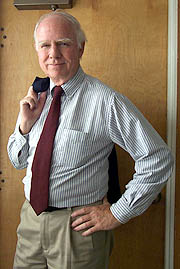
Peter Hockaday |
Q: What is your firm's specialty?
A: We have a broad practice, but since the beginning of the firm we have also specialized in buildings of technical complexity, science research and complex manufacturing, as well as computer centers. Our first client of this type was Chevron Research, and we did all of the Chevron Research buildings. This gave us an understanding of the practicalities of laboratory design and buildings that need to perform safely, which are used for chemistry and complex research activities. From that, we began in the '60s to develop skills in biotechnology and pharmaceutical work, and were soon doing buildings of this type for the private sector and for universities throughout the country.
Q: What are a few of your favorite projects?
|
|
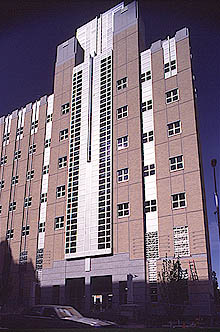
Harborview's new Research & Training Building presents an Art Moderne facade. |
Q: What does it take to design buildings for technically complex uses?
A: First you need to start by being interested in science and being sympathetic with science. You have to understand these buildings from the point of view of the scientist, so that you can think about how people will perform in these spaces safely and in a pleasant environment. We are interested in how teams perform science and the communication between the scientists, and we need to understand the equipment that's used in a research lab. These buildings are inevitably extremely complicated and relatively expensive. Therefore, they represent a major investment for an institution or venture capital-funded company. You try to understand these buildings as if they were your own, as if you were living there like a client would.
Q: How much understanding of science and technology does your firm need to design these buildings?
A: It's not a question of understanding the research being done, because this research is at the leading edge and often involves the results of many years of studying and training. You need to know their needs for space and furniture, and equipment needs and specialized services such as gases and deionized water.
Q: How important is the shell of the building for your clients?
A: The shell of the building is really very important. These high-tech buildings do not fit comfortably into a high rise office building or a standard commercial structure. Inevitably, the research requires high volumes of air and special services and floors free of vibration, and these are not usually available in commercial buildings. The Rosen Building suits the needs of the institute because it's a heavy concrete shell and has very high floor-to-floor heights, so there's just enough space to accommodate the air and services.
Q: How do your designs respond to adjacent buildings?
A: Frequently our buildings are on university campuses, frequently historical campuses. We're very interested in maintaining the character of a university setting while accommodating a building that often has fewer windows and complicated rooftop requirements and massive floor plates. So your challenge is to create a building that fits into a historical university, even though it's got a 21st century program inside. We enjoy doing university work for this reason.
Q: What sort of work are you doing for Sound Transit?
|
|
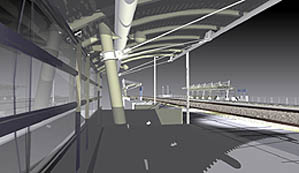
Sound Transit's Kent Station will connect to the business district, parking structure and new public library. |
Q: What do you enjoy about designing transit stations?
A: In some ways you're freed from the constraints of complex buildings in that you don't have complicated mechanical and electrical services. Being open air structures, they can be less restricted in their design. It's also an enjoyable experience in placemaking, trying to bring out the character of the community using the station.
Q: What local architecture are you fond of?
A: I am intrigued by Seattle's Art Moderne work. I like the Exchange Building and some of the terra cotta exteriors on buildings like the Arctic Building. Those are wonderfully expressive pieces of architecture from a relatively adventurous period in architecture. I'm still looking for the perfect symbolic piece of Northwest architecture. Everybody talks about Northwest architecture, but when you get down to it there do not seem to be many perfect examples.
Q: How did you get started in architecture?
A: I started out as a science major at Yale. But at the same time I enjoyed drawing, and architecture was about the only profession I could find that seemed to fill my creative and scientific requirements at the same time.
Q: What do you enjoy about being an architect?
A: I like getting up in the morning and coming to work every day and still being energized by what might be happening that day. In every aspect of architecture, there is an opportunity to be creative and that is enough for me.
Previous columns:


