 |
Subscribe / Renew |
 |
Contact Us |
| ► Subscribe to our Free Weekly Newsletter | |

Construction Bids
| home | Welcome, sign in or click here to subscribe. | login |


 print print  email to a friend email to a friend  reprints add to mydjc reprints add to mydjc |  |

September 1, 1999

By SAM BENNETT
Journal Staff reporter
|
|
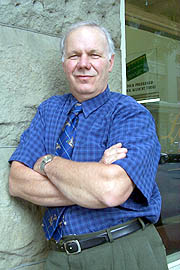
Tom Holz |
Q: What does your firm do?
A: We provide professional transportation engineering and planning services to municipal, county and state agencies throughout the Puget Sound region. Our services include engineering design, land surveying, hydrological services and environmental planning and permitting.
Most of our clients are from the public sector. We also provide civil engineering services for land development projects throughout Washington state. Our firm provides innovative transportation and design solutions.
Q: What are a few recent projects you are proud of?
A: I'm writing revisions to the Snohomish County development code which would require zero-impact developments in some kinds of watersheds. It's still in the draft form. If adopted, it would require development with minimized impervious surfaces and large sections of forest left as permanent native growth protection areas in certain watersheds as opposed to the kind of development where the first thing they take is the entire forest and soil.
|
|
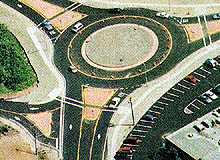
The Port Orchard Bethel Avenue triangle intersection was converted into a
roundabout designed by SCA. |
Through the course of two years of working with the city, the modern roundabout was chosen as the preferred design. Since its construction in 1997, there have been no reported accidents at this location, where, previous to its installation, more than two collisions occurred each month.
The modern roundabout provides more efficient and safer circulation than a traditional traffic signal. We're currently building two roundabouts in the city of Lacey and in the design process for two roundabouts in the city of Olympia.
Q: What is an example of your survey department's work?
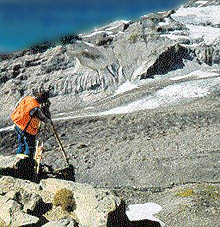
A: Our company surveys the Nisqually Glacier on Mount Rainier to identify its movement on an annual basis.
|
|
SCA engineers monitor the Nisqually Glacier on Mount Rainier, in part to measure the impact of global warming. |
Q: How has the city of Lacey taken an interest in your zero-impact proposal?
A: The SCA staff has been working with the city of Lacey for nine months or more, explaining why they need to be a leader in promoting zero impact. After many meetings with the the Utility Committee and City Council, they were convinced that this was the wave of the future and they wanted to take a leadership role.
So they passed an ordinance on [Aug. 26], and the effect of the ordinance will be to allow a demonstration project to be built that will have no impact on downstream fisheries. Passing the ordinance provides a regulatory path to getting the development approved.
And because SCA supports this new concept, we're in the process of building an office building and parking lot for SCA's new headquarters that will have zero impact aspects to it, which will be constructed next year.
Q: What personal reasons do you have for pursuing zero impact?
|
|
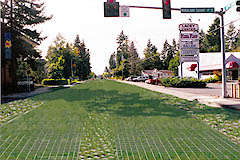
A rendering of Lacey's Sixth Avenue shows SCA's proposal for replacing asphalt with steel bridge decking over grass. |
Q: Since your firm has grown so rapidly in recent years, what other areas have you expanded into?
A: We have permit specialists who deal with day-to-day regulatory issues, and overcoming the challenges associated with getting a project approved in today's environment. The better we can navigate a project through the approval processs, the more competitive our clients can be in developing their property because of the adage: time is money.
Another element of the company we're beginning to develop is the design-build concept. We're now working on a couple of large subdivisions where we are preparing the design plans, constructing the project and handing over a completed development to the developers.
This allows them to work with one entity versus multiple companies in getting their project built. Under this scenario, our firm is leading the design and construction phases, so it eliminates the interface between the contractor versus the engineers.
Through research, we're finding there is a cost savings of 20 to 30 percent in developing a design-build project. That is a new trend going nationwide.
Q: What would you say is the hallmark of your firm?
A: One of the things we're proud about in our company is the innovative design solutions we come up with. We don't have cookie-cutter designs, and we're not afraid to evaluate other alternatives that are non-traditional. A common theme we hear from our clients is that we are preferred because we find the best solutions for the most difficult projects.
Previous columns:


