 |
Subscribe / Renew |
 |
Contact Us |
| ► Subscribe to our Free Weekly Newsletter | |

Construction Bids
| home | Welcome, sign in or click here to subscribe. | login |


 print print  email to a friend email to a friend  reprints add to mydjc reprints add to mydjc |  |

January 19, 2000
|
Why does your Seattle office specialize in waterfront engineering?
We do a lot of waterfront work throughout the company. It's kind of a specialty of PN&D firm-wide, but even more so in this office because the environment around here is so water oriented. Primarily it's because of the interests of the principals who work here. All of us have come out of the Anchorage or Juneau offices at some time. We are the office with the most expertise in water structures in the company.
Which projects best represent your firm?
One project that is receding into history a little bit is the Bell Street Pier project. We were the prime marine structural engineer. The cruise ship pier, the transient moorage, the state-of-the-art wave barrier, the bulkhead repairs -- all those are highlights of what we do.
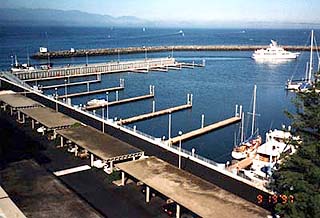
But beyond that there are some more recent projects, such as the Pier A project at Shilshole Marina. That was a project involving a public access pier -- a pier that was also part of the working waterfront for the fishing industry. It used the next generation of the PN&D wave barrier which is a type of breakwater that provides good protection in the medium wave environment that we have here in the Puget Sound. That was a project that was about as perfect as possible.
|
Working under water is extremely complicated and it's getting more complicated all the time. You can't see a lot of what you're doing -- you're driving piles underwater, you're doing demolition of existing structures underwater. The structures you put under there are subject to severe wave environments -- wind, tidal action, currents. On top of all that, the regulatory environment has gotten so restrictive, it's very difficult to actually do something which will satisfy all the habitat protection agencies.
How has PN&D innovated in the area of breakwaters?
With breakwaters in the past, you've been limited to what you can do. They have rock breakwaters, such as Shilshole, which are very expensive to do now plus environmentally they're not viewed as very habitat friendly. You also have floating breakwaters, but they can't handle very high waves. In Puget Sound we get a lot bigger waves than that, but we don't get the type of waves we get in the Pacific Ocean where a rock breakwater might be the only way to go. So we've come up with a fixed pile supported breakwater that is a barrier supported on vertical piles. Structurally waves impart very large forces on a structure. So the piles have to have capacity to resist very large forces. The Bell Street Pier has a wave barrier which is probably the biggest or highest capacity wave barrier we know of. It's capable of resisting waves 9 or 10 feet high. And Pier A is the next generation of that kind of wave barrier. They're becoming much more economical and effective at protecting vessels.
What work are you doing on South Lake Union Park?
The city's focus there is to develop a public access facility, a maritime heritage center, on what is already there. The first project we were selected for was to re-build the wharf in front of the old Naval Reserve Building and provide moorage for active vessels that are part of Seattle's maritime heritage. It's going to be a working waterfront. So one of the challenges is having that public access to a pier facility and then also carry on the activities of the vessels themselves. The public access will be the biggest challenge because the city envisions a real active park and a lot of people using it. We want to make sure it's safe, attractive and provides all the interpretive features that are needed. This is going to set the tone for the rest of the park.
What other types of projects is PN&D involved with?
|
Are you doing work overseas as well?
We are working in Russia. It's probably our biggest foreign involvement. We're doing work for the oil industry in Sakhalin Island and the fishing industry in Kamchatka and different types of transportation and forestry related things in other parts of Russia. We feel very fortunate because we've actually made money working in Russia, and we understand that's quite rare.
How did you become interested in engineering?
I've always been interested in international travel. But 20 or 25 years ago when I finished my degree at the University of Washington, I started looking around and saying, "I need a trade." I looked at all the different types of fields available and it looked like civil engineering was most portable, and it appealed to my interest in science and mathematics. So I got a civil engineering degree from the university. One of the reasons we like to innovate is it keeps what we do interesting, to always try to be thinking about a better way. If you're taking (everything) off the shelf, this can get to be quite boring quickly. I think that translates into benefits for clients as well.
Previous columns:


