 |
Subscribe / Renew |
 |
Contact Us |
| ► Subscribe to our Free Weekly Newsletter | |

Construction Bids
| home | Welcome, sign in or click here to subscribe. | login |


 print print  email to a friend email to a friend  reprints add to mydjc reprints add to mydjc |  |

October 6, 1999

By SAM BENNETT
Journal Staff reporter
|
Q: What do you do at HWA Geosciences, Inc.?
A: I'm currently manager of the geotechnical group and acting manager of the laboratory and construction services group. I have actually three groups under my direction. I have quite a broad background and have been involved in laboratory and construction services related work in the past.
Q: What projects are you most proud of?
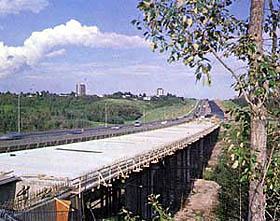
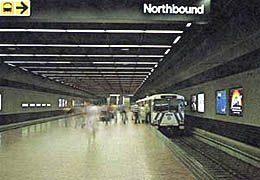
A: There are a couple projects I'm particularly proud of which preceded my current tenure with HWA, and those were projects in Canada. The Edmonton Rapid Transit System project involved design and construction of the first section of the light rail transit which the City of Edmonton undertook to service the transportation needs for the 1978 Commonwealth Games and for future growth.
Most of the system is at grade and shares the right-of-way of the Canadian National Railway through the city. However, the line departs from this right-of-way and goes below ground in tunnel sections through the downtown core. The first leg, or North East section, involved about one-half mile of tunnel and two underground stations. To limit the amount of disruption to heavy downtown traffic, innovative use of tangent pile walls was adopted. The design and construction of this section of line was awarded the 1980 Association of Professional Engineers, Geologists and Geophysicists of Alberta Achievement Award.
|
There is about a thousand feet of wall involved and over 1,100 anchors on eight levels holding the walls back. The structure sits within this retained excavation, which is in part encroached upon by an old active landslide. I was the manager and senior geotechnical engineer of the geotechnical design team and part of the overall architectural and engineering team. This was done in the late '70s. The structure was completed in '78 and it's still standing with no evidence of any detrimental movements.
Q: What other areas does your firm specialize in?
A: We do a lot of stormwater management work. This involves infiltration and detention systems. In this area, unlike Vancouver, B.C., there is a lot of stormwater management that's handled through detention and infiltration ponds; the latter in areas amenable to allowing the water to percolate downwards into the soil and thereby dissipate major stormwater runoff peaks that occur. I find that's a particularly challenging area because there is a geotechnical component in the design of these ponds as well.
I've had the good fortune to work with our hydrogeological people to provide geotechnical design input. For example the slopes of the embankments, how the embankments will perform under fluctuating water conditions within the ponds, foundation requirements for inlet/outlet works and that sort of thing. So that's a very big area of our company practice.
Q: What brought you to Seattle from Vancouver?
A: What really attracted me here was the understanding that Seattle was about to embark upon a fairly ambitious light rail transportation system. I was very interested in coming down and participating in that, with my background in transportation projects. When I moved from Edmonton to Vancouver in 1989, after construction of Vancouver's Sky Train, there was an expansion of the system after I arrived, though I played a minor role in that. They are expanding the system again and I did a little pre-design work associated with the next extension of the Sky Train system.
So I'm hoping to take a major part in this work, and hoping that HWA will be favorably positioned to get a pretty good chunk of the action, so to speak, so I'm looking forward to it. I think we stand a good chance to be selected to do the geotechnical design for some part of it. There is a lot of tunnel work, so we would be doing investigation work to determine what the deposits are along the route and also to provide design pertinent to the tunnel and stations involved in the project.
Q: How do you like working in Seattle compared with Canada?
|
I also like the fact that there's much more work going on in terms of infrastructure upgrading. I'm currently involved in four bridge projects Ð bridges that really are overcrossings. These are de-bottlenecking types of projects. When I arrived in Vancouver I was fortunate enough to be involved in a major de-bottlenecking of the Trans-Canada Highway which runs through the City of Vancouver. The Trans-Canada used to come into the City on the east side and basically just dump right into the city, so all that traffic would just pile up there. I was the geotechnical engineer on that and spent about three years in the design and construction phase. the project involved two tunnels and 15 interchange structures over the Trans- Canada and about 20 retaining walls and a couple miles of roadway. It was really gratifying to be involved in that project.
The other thing that's really attracted me to the area is the fact that I find the economy is so much more dynamic at the moment than things are in British Columbia. So when I had the opportunity to come down and join the firm, it didn't take long for me to make the decision that this is what I wanted to do for the balance of my career. I've had more work and a better business environment to do it in.
Q: How did you get interested in this field?
A: I was born in Alberta and was educated in Edmonton at the University of Alberta, where I received my bachelor's and master's in soil mechanics. What got me into engineering was my father who was involved in construction and he was probably a driving force in that area. It seemed logical since I had an affinity towards the construction end of things that engineering was the discipline that I wanted to pursue.
Previous columns:


